

Transforming into a Customer-Centric Leader
Customer-centricity is not a new phenomenon. References can be traced back to the 1950s when the esteemed Austrian-American management consultant Peter Drucker coined the term to describe the importance of building relevant solutions to meet customers’ needs. But measuring the importance of putting customers at the center of your business and objectively putting a value on its impact is a relatively recent happening.
Renowned Harvard professor Ranjay Gulati revealed from his research in 2009 (“Reorganise for Resilience”) that outside-in businesses were significantly more productive than their inside-out counterparts – revealing growth of 150% shareholder returns compared to 14% for the S&P 500 between 2001 and 2007.
Forrester reinforced this same principle in 2012, after 14 years of research, in their book “Outside In: The Power Of Putting Customers At The Center Of Your Business”.
In 2021, Fred Reichheld, the inventor of the Net Promotor Score (widely acknowledged as the benchmark for measuring how well an organization treats the people whose lives it affects), demonstrates in his book, “Winning on Purpose,” how exemplar NPS companies outperform their stock market peers.
So, the correlation between customer-centricity and profitability is irrefutable. Given the compelling evidence, why did a recent Bain & Company survey (July 2021 Bain survey of customer executives) reveal that only 10% of business leaders believe that the primary purpose of their firm is to maximize customer value? It seems from the research that many of them make their default ‘north star’ as delivering shareholder value…which, while not a foolish goal, misses the more critical and primary creation of shareholder value – the customer. As Peter Drucker said, “It is the customer who determines what a business is. It is the customer alone whose willingness to pay for a good or for services converts economic resource into wealth…what the business thinks it produces is not of first importance. What the customer thinks he or she is buying, what he or she considers value is decisive – it determines what a business is, what it produces and whether it will prosper.”
If the primary purpose of an organization is to enrich the lives of customers, then the driving force behind this ambition sits with the leaders of the business. Becoming a customer-centric leader requires more than a series of PR platitudes and random customer hugging. It requires a commitment to a structure of consistent behaviors and actions that, over time, transform the culture of the organization. It’s a science, not an art.
For clarity, I define customer-centricity as; ‘putting the customer at the core of your company in such a way that it influences the business decisions you make. It requires a mindset across a connected organization whereby everyone is focused on creating long-lasting value for the customer’. Customer-centricity is a culture – not a strategy. It needs to be considered as a transformation initiative powered by strong leadership.
I have simplified the critical requirements of customer-centric transformation, leveraging McKinsey’s “Influence” model. Here are the four building blocks required to transform into a customer-centric leader, with some example initiatives.
-
Create a Compelling Story
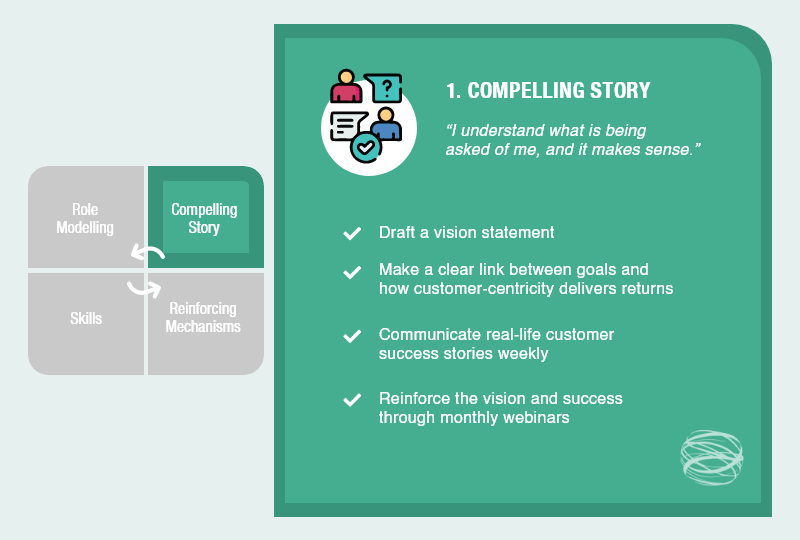
People across the organization need to understand what is being asked of them and feel that it makes sense. They naturally seek congruence between their beliefs and actions – in other words, believing in the “why” inspires them to behave in support of the agenda.
The story needs to be based on a vision that the company can rally around – which is inspirational, simple, clear, and supported by a business plan. It needs to demonstrate believable impacts on the customer experience, which link to measurable economic outcomes. In other words, “if we behave in this way, we create value for our customers and value for us.”
This story needs to be reinforced on a regular basis via a drumbeat of monthly communications, webinars, roadshows, etc. Crucial to these communications are real-life case studies demonstrating how the vision is coming to life e.g., by showcasing how we have helped a customer achieve their goals and increased their loyalty through the services we have provided.
2. Role Modelling
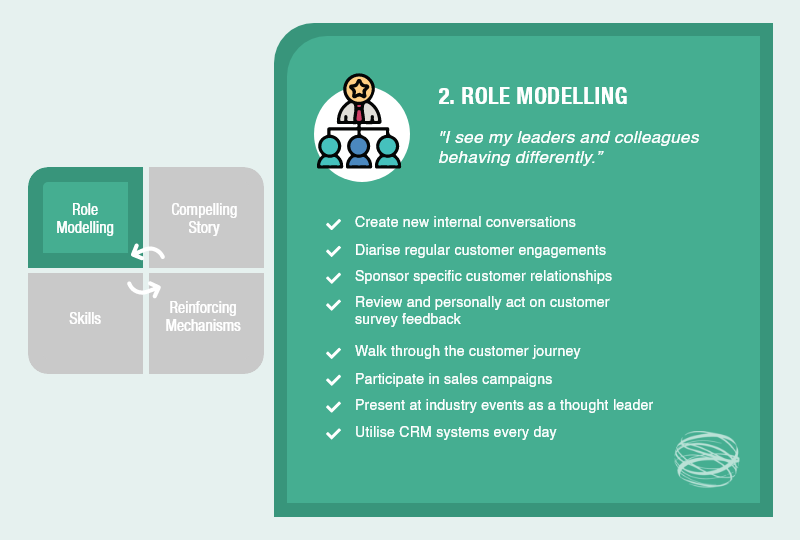
People mimic the individuals and groups that surround them – both consciously and subconsciously. So, it’s crucial that leaders are seen to be acting and communicating in ways that are aligned to the vision that they’ve painted. Leaders are role models, and there are a number of techniques we can use to leverage this position.
Internally, conversations are probably the smallest and biggest thing in making customer-centric transformation happen – they are overlooked as a catalyst for change. Our work life can be seen as a series of conversations, whether in meetings, in the car, online, or at coffee machines. They are a trigger point for transformation, and we need to be more intentional about the way we use them. As an example, we should consciously ask questions of colleagues about what challenges our customers are facing or what is happening in their industries – not randomly, but every time we bump into them.
Externally, leaders need to be visibly engaged with customers – and on a regular, diarised basis. This may take the form of one-to-one meetings, hosting group seminars, participating in campaigns (‘Back to the Customer’s Floor’ is my favorite), or presenting at industry forums. Importantly, customers expect you to have opinions as a thought leader…so be prepared to express them!
3. Build Customer-Centric Skills throughout the Organization
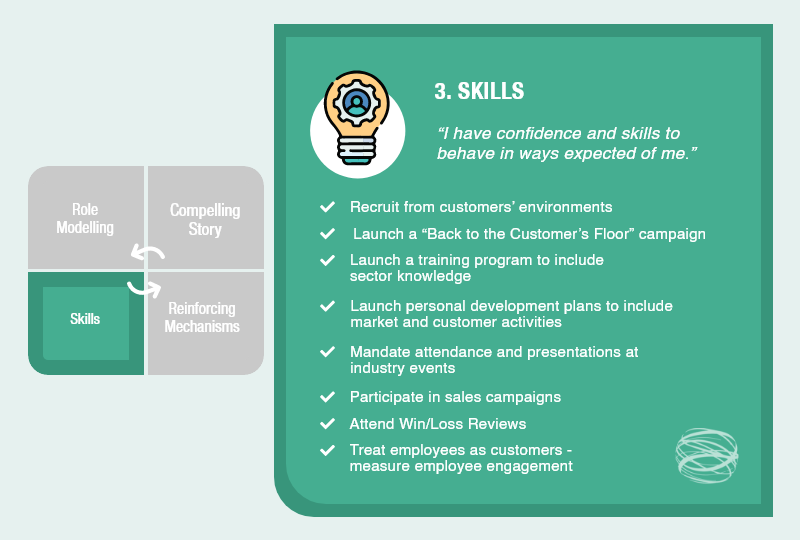
If we, as leaders, want our people to behave in a different way, we must recognize that our employees may need to build dramatically new skills. We may need to supplement our resources with new recruits. Research proves that not only can you teach an old dog new tricks, but “the opportunity to learn” is regularly cited in employee engagement surveys as one of THE most important factors in staff retention. Hence, we should treat our employees as customers and make sure we invest appropriately.
Aside from the basic skills required in formal job roles, learning programs should include customer industry content to ensure we are getting closer to market dynamics and sector idiosyncrasies. We can be imaginative about how we build knowledge in our teams; for example, we can set targets for people to present at industry forums or to attend customer industry events. Equally, we can set disciplines around engaging with our customers’ eco-system of partners to get a 360-degree perspective.
Another highly effective way to accelerate market culture across teams is to recruit directly from the customers’ environment. These recruits automatically inject a fresh perspective, think ‘outside-in’, and use customer language naturally. Product knowledge can be taught, with the potential to better shape and describe solution benefits.
4. Build Reinforcing Mechanisms
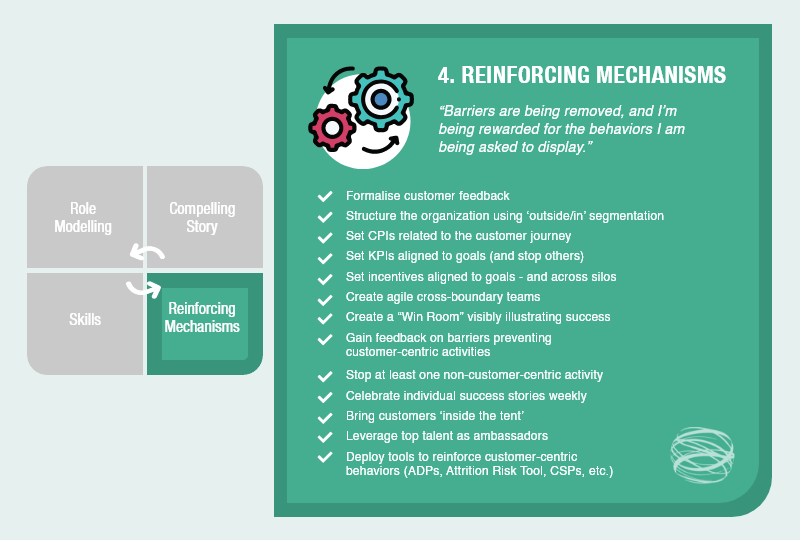
Teams need to feel that they reside in optimized organizations, that barriers are being removed, and they are being rewarded for the behaviors they are being asked to display. As such, this building block requires careful consideration and a range of interventions in order to create a positive environment for people to thrive.
The operating model needs to be based upon growth-orientated, outside-in segmentation and with smart use of agile, cross-silo teams empowered to make decisions. Skills need to be assessed and aligned. Incentives need to be deployed consistently across divisions and align to Customer Performance Indicators (CPIs), i.e., demonstrating how our services have created measurable value for customers. Internal Key Performance Indicators (KPIs) need to align to the overall goals of the business and be visibly celebrated right across the company.
Teams should be empowered to identify time-wasting tasks that prevent success, and the leadership should ensure they are removed.
A range of simple tools need to be deployed to formalize how we retain, delight, and grow customers professionally, e.g., a playbook, attrition risk process, customer engagement plans, etc.
Equally, as a leadership team, we must deploy a simple governance process that gives clarity, control, and visible management of the critical customer-centric measures we have advertised. And we should be seen to stop measuring irrelevant ones.
Conclusion
In conclusion, this is just a sample of potential initiatives and behaviors that collectively underpin customer-centric leadership. However, it is critical that all four building blocks are executed simultaneously and consistently. If leaders tell a compelling story with ambitious goals but fail to measure any success associated with them, credibility will evaporate quickly.
The key here is to create leadership discipline. These activities need to be formalized within this structured framework, with a commitment to execution and a willingness to be held accountable across the leadership team. Only then will shareholder value be created through the enrichment of customers’ lives.